

Google Ads works for B2B lead generation when you fund, structure, and measure it as a pipeline program.
In practice, the program has to capture real buying intent, filter for fit, keep attribution intact into the CRM, and make budget calls from qualified opportunities instead of clicks or lead counts.
Say you inherited an account with a healthy conversion count and a sales team that doesn’t trust the leads. Where’s the problem? It’s rarely one bid setting. It usually spreads across four connected choices. Which demand do you pursue? What does the ad promise? Which conversion is the platform rewarded for? Does your CRM tell Google Ads which leads turned into pipeline?
This guide works through each of those choices from a leadership seat.
Table of Contents
- Where Does Google Ads Fit in a B2B Demand Strategy?
- Qualified Pipeline Is the Governing Measure
- Search Intent Decides Which Buyers You Pay to Reach
- Build an Account Structure Leadership Can Read
- Connect Google Ads to a CRM You Trust
- Size the Budget From Your Pipeline Math
- When Does Google Ads Show Pipeline Impact?
- Paid Media Can Only Amplify the Offer You Bring
- Why Do B2B Google Ads Programs Stall?
- What Should Leadership Expect From a Well-Run Program?
- How DC4 Approaches Google Ads
- Explore the Full Series
- Frequently Asked Questions
Where Does Google Ads Fit in a B2B Demand Strategy?
Google Ads fits best when buyers already know they have a problem, can describe it in search terms, and are ready to evaluate a fix. It captures demand that already exists. It can’t create a market on its own, though it will quickly expose gaps in your offer, your landing pages, and your sales handoff.
For a VP of Marketing or Director of Demand Generation, that’s the first funding decision. You’re paying to show up at the moment a buyer declares a need. The channel earns a bigger role when that declared demand is worth a lot to you and your team can tell a serious prospect from a convenient form fill.
| Condition | Google Ads role | Leadership implication |
|---|---|---|
| Buyers search for the problem or category | Demand capture | Fund coverage of high-value intent and judge it by qualified pipeline. |
| The category needs education before buyers search | Supporting channel | Use content, LinkedIn, events, or other demand creation to build familiarity first. |
| The offer is weak or undifferentiated | Diagnostic pressure | Fix the offer and message before asking paid search to scale. |
| Sales can’t classify lead quality consistently | Limited learning system | Repair the handoff and lead definitions before automating toward deeper outcomes. |
Channel comparisons need the same care. LinkedIn can build awareness with named roles and accounts before they ever search. Organic search compounds across a wide set of questions over months. Google Ads moves faster, but its ceiling is set by how much demand exists, how crowded the auction is, and what happens after the click.
When Google Ads is the wrong first move
Hold off on Google Ads until the fundamentals are in place. Spending before then just gets you bad signals faster. These are the clearest signs you’re not ready:
- Buyers don’t search for your category, problem or alternatives in meaningful numbers yet.
- Your team can’t explain why the offer is better for a specific buyer in a specific buying situation.
- The promoted asset draws broad interest but gives qualified buyers no reason to take the next step.
- Lead routing, response ownership or CRM stages are inconsistent enough that outcomes get lost after the form.
Qualified Pipeline Is the Governing Measure
Judge a B2B Google Ads program by what it adds to qualified pipeline. Clicks and form fills are diagnostic signals. Lead volume can climb while sales confidence drops, and when that happens, the account is optimizing toward something sales doesn’t value.
When we take over an account, one of the first things we check is which conversion action the bidding is rewarded for. Sometimes there isn’t one at all. More often it’s an old form fill on a page nobody has updated in a while, and nobody on the sales team is paying attention to it. Which conversion is your account rewarded for today?
Leadership needs a measurement ladder that keeps each metric in its place.
- Traffic metrics explain reach, relevance, and auction pressure.
- Conversion metrics explain whether the message and page move people to act.
- Qualification metrics explain whether paid search reaches buyers sales wants to pursue.
- Pipeline metrics explain whether the channel deserves continued or increased investment.
A lower cost per lead isn’t automatically an improvement. If cheaper leads qualify at a lower rate, the savings only exist in the report. We’d rather see fewer credible leads with a clear path to opportunity than a queue of names sales stops working.
Search Intent Decides Which Buyers You Pay to Reach
Keyword selection is the first lead-quality decision in a Google Ads account. Every keyword is a bet on who’s searching and why. A search for a problem, a category, or an alternative to a named competitor usually signals someone evaluating options. A search that includes “free,” “jobs,” “course,” or “definition” usually signals someone who will never buy.
The useful leadership question is which keyword themes produce buyers sales wants to talk to. Judge them by the qualified leads and opportunities they produce. Search volume and cost per click describe the auction, not the buyer.
Broader matching makes this harder to control. Broad match and AI Max both let Google decide which searches are close enough to your keywords, so regular search term reviews and a maintained negative keyword list matter more now than they did a few years ago.
Our guide to choosing the right keywords for B2B Google Ads covers how to evaluate keywords by pipeline. For audience targeting, see our earlier post on Google Ads optimization for B2B keywords and audiences.
Build an Account Structure Leadership Can Read
Google Ads account structure is a measurement decision. Campaign boundaries decide where you can compare budgets, queries, offers, and outcomes cleanly. A tidy account can still be useless for analysis if it mixes very different kinds of demand.
Test your structure against four questions. Which demand created qualified pipeline last quarter? How much of it was existing brand demand? Which offer produced sales-accepted interest? Where did extra spend stop producing useful outcomes? If your team has to rebuild the report every month to answer them, the structure is in the way.
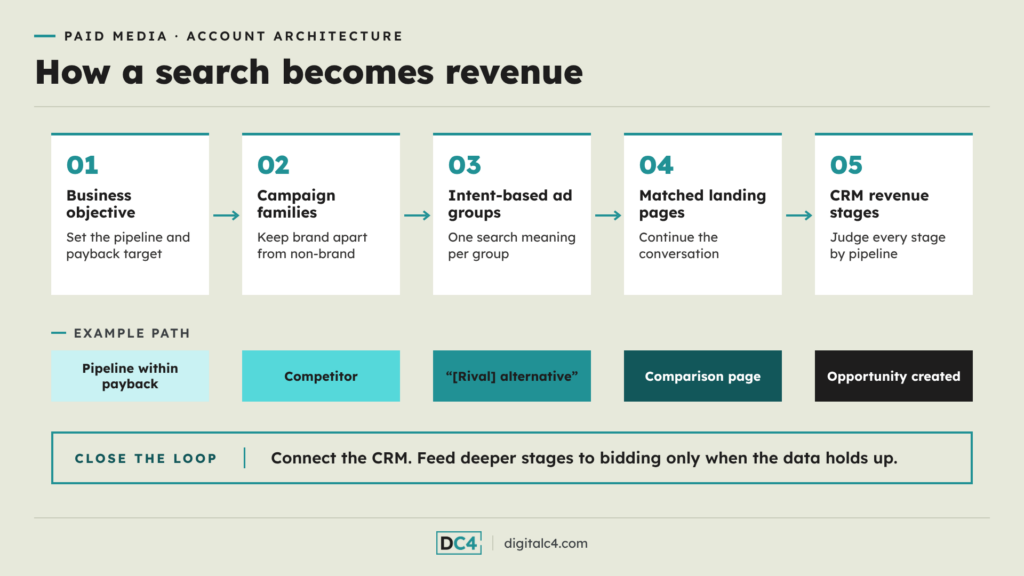
Two principles carry most of the weight. Keep brand and non-brand campaigns separate, because cheap brand conversions hide the true cost and quality of new demand. Then group non-brand campaigns by the intent the search reveals, so different buyers and offers stay visible enough to compare.
Restructuring has a cost. Bidding needs time to relearn, and historical comparisons get harder. Restructure when the current setup blocks credible budget decisions, not because the account looks untidy. How Google Ads account structure affects your pipeline visibility covers when a restructure is worth it and what it disrupts.
Connect Google Ads to a CRM You Trust
Connecting Google Ads to your CRM is the goal, and the quality of the CRM data decides how far the program can optimize toward pipeline. An integration won’t fix inconsistent stages, missing click IDs, duplicate records, or uneven sales follow-up.
We connect Google Ads to the CRM when the CRM supports it natively, as HubSpot does. We rarely build optimization around uploaded offline conversion data, because most CRMs don’t hold paid media outcomes accurately enough to steer bidding. We’ve used offline conversion imports only a handful of times, when the data was trustworthy enough to support it.
When we open the CRM on a new account, we often find leads tagged only as “Google.” We can’t tell whether they came from paid search or organic, let alone which campaign or search term produced them. That gap alone limits how far bidding can go.
- Define the business stages. Marketing and sales need the same meaning for inquiry, qualified lead, accepted lead, opportunity, and closed business.
- Preserve attribution inputs. Click IDs and first-party data have to survive the form, routing, enrichment, and CRM processes.
- Audit stage behavior. Confirm reps apply stages consistently and automation isn’t overwriting the evidence.
- Promote outcomes carefully. Use deeper stages for reporting or bidding only after their volume, timing, and accuracy are stable enough to learn from.
Google now steers advertisers toward enhanced conversions for leads through Data Manager for importing qualified and converted lead outcomes, and calls the older offline import a legacy feature. The platform support exists. Data readiness is a separate question, and a technically clean upload can still teach the account the wrong lesson.
Marketing Clarity: Knowing What Matters Gets Harder
Our perspective on reading marketing signals deliberately as channels, tools, and data multiply.
Size the Budget From Your Pipeline Math
A defensible Google Ads budget starts with your own revenue model, meaning deal value, close rates, sales capacity, and target acquisition cost. Industry benchmarks can’t tell you what a qualified opportunity is worth to your business, because they average companies with different contracts, margins, and sales motions.
Work backward from the outcome. The math doesn’t need to predict every auction. Its job is to show what has to be true for the program to make economic sense, and which assumption needs the closest watching.
- Set the pipeline or revenue contribution the channel is expected to support.
- Apply your observed opportunity-to-customer rate to estimate the opportunities required.
- Apply your observed qualified-lead-to-opportunity rate to estimate the qualified leads required.
- Use your acceptable customer acquisition cost and non-media costs to set the spend ceiling.
- Compare that requirement with actual search demand and the account’s ability to convert it.
Here’s how the math runs with illustrative numbers. They’re invented to show the method and don’t come from a client account.
| Input | Illustrative value | Result |
|---|---|---|
| New customers needed from Google Ads this year | 10 | Target |
| Opportunity-to-customer rate | 25% | 40 opportunities needed |
| Qualified-lead-to-opportunity rate | 40% | 100 qualified leads needed |
| Acceptable acquisition cost per customer | $15,000 | Set by finance |
| Non-media cost per customer (management, tools, sales time) | $4,000 | $11,000 media budget per customer |
| Annual media budget ceiling | 10 customers x $11,000 | $110,000, about $9,200 a month |
| Maximum media cost per qualified lead | $110,000 / 100 leads | $1,100 |
If current search demand can’t produce 100 qualified leads a year at or below $1,100 each, the plan needs a smaller channel role, a better close rate, or a stronger offer.
Give each input an owner and a confidence level. Finance may own acceptable acquisition cost. RevOps may own stage definitions and close rates. Demand generation may own channel conversion assumptions. When an input is weak, label it as an assumption instead of burying it in a precise-looking forecast.
Budget is also a learning constraint
A budget that’s too small for the available auctions and the sales cycle produces activity without enough evidence to separate signal from noise. A bigger budget doesn’t guarantee learning either. If the account mixes intent, counts weak conversions, or changes direction every few weeks, more spend buys a bigger, murkier dataset. Fund the program long enough to see query quality, conversions, qualification, and pipeline move, and keep the right to reallocate when those layers tell a consistent story.
When Does Google Ads Show Pipeline Impact?
Google Ads produces traffic and early conversions within weeks, and credible pipeline evidence usually takes at least one full sales cycle. With a 90-day sales cycle, expect at least a quarter of steady spend before opportunity data says much. Search volume, conversion volume, and how fast sales qualifies leads all move that timeline.
Leaders should expect different evidence at different points. Early signals describe coverage and traffic quality. Next come conversion and qualification. Opportunity creation and revenue arrive last, often after the team has already made several operating decisions.
| Evidence stage | What can be learned | What should wait |
|---|---|---|
| Auction and query behavior | Whether the account reaches relevant searches at viable cost | Claims about lead or pipeline quality |
| On-site conversion behavior | Whether the message and page produce intended actions | Claims that form fills are commercially useful |
| Qualification and sales acceptance | Whether the channel reaches companies and people worth pursuing | Final CAC or revenue conclusions |
| Opportunity and revenue progression | Whether spend contributes to pipeline and customers | Nothing, provided attribution and CRM data are reliable |
Staging the evidence prevents two common mistakes, declaring success from early lead volume and declaring failure before the sales cycle has run. It also lets leadership hold the team accountable without pretending every question can be answered on the same date.
Paid Media Can Only Amplify the Offer You Bring
Paid media amplifies the offer, product, brand, and assets a company brings to it. Strong execution can’t rescue a promise the market doesn’t value, a landing page that breaks the message, or an asset that attracts curiosity without buying intent.
We treat this as shared accountability. The media team should flag the weaknesses it can see, show how they appear in the data, and recommend changes. Leadership still decides whether the proposition, proof, and assets can change.
In B2B accounts, we often see a well-run search program promoting a gated ebook that pulls in researchers and students, or sending clicks to the site from people who were looking for a login page. The program then takes the blame when sales can’t find a buyer in the list.
- Ad promise: Does it say something specific enough to attract the right buyer and discourage the wrong one?
- Landing experience: Does the page continue the promise, establish credibility, and make the next step proportionate to intent?
- Promoted asset: Does the ebook, webinar, or assessment create a useful buying signal, or only a large audience of researchers?
- Sales response: Does the follow-up match what the person asked for, and does it happen while the context is still fresh?
Ad copy is the first filter in that chain. Qualifying language, such as naming the company size or deal type you serve, discourages poor-fit clicks before you pay for them. Using Google Ads copy to filter for qualified leads explains why a lower click-through rate can be good news.
A mature review separates media, offer, conversion, and sales problems, then hands each one to the team that can fix it.
Why Do B2B Google Ads Programs Stall?
B2B Google Ads programs stall when the account optimizes toward an easy proxy while the business expects a harder outcome. The symptoms show up in media reports. The cause can sit in strategy, data, offer quality, sales follow-up, or operating discipline.
- Lead volume became the goal. The team grew form fills while qualification and sales acceptance slipped.
- Brand demand inflated acquisition results. Reports blended existing awareness with new non-brand demand.
- Campaign structure hid the tradeoffs. Different intent, offers, and economics shared budgets or goals.
- The CRM couldn’t return a dependable signal. Stages were missing, delayed, overwritten, or applied differently by each rep.
- Automation got weak inputs. Bidding chased the conversion action available instead of the outcome leadership cared about.
- The offer stopped carrying its weight. Media changes were asked to solve a message or product problem.
- The program changed too often. Campaigns, pages, budgets, and goals were reset before the last decision could be read.
A stalled program rarely needs a full rebuild. It needs a diagnosis that finds the narrowest constraint that explains the evidence. Sometimes the problem is query quality. Sometimes it’s a landing page promise. Sometimes the channel is working and the pipeline record is incomplete. A useful audit tells you which layer is failing, what evidence supports that read, and which decision should change next.
Fix the largest uncertainty first
Optimization works best as a sequence, starting with whatever the team is least sure about. If the search terms are off, there’s little point debating the form. If traffic is credible but qualified leads are thin, look at the offer, the ad promise, and the landing page before the bid strategy.
Protect an evaluation window for every meaningful change. Search term quality can be judged within weeks. Opportunity creation takes a sales cycle. Changing budgets, goals, campaigns, pages, and lead definitions at once is like adjusting the thermostat, opening the windows, and lighting the fireplace in the same hour, then trying to work out which one warmed the room. Good teams document the hypothesis, the change date, the leading signal they expect, and the business outcome that will confirm it.
How to tell if your Google Ads program is producing pipeline walks through the full diagnostic, including how to separate a channel problem from an execution or offer problem.
What Should Leadership Expect From a Well-Run Program?
A well-run B2B Google Ads program gives leadership a traceable line from spend to pipeline, including the limits of the evidence. The team should be able to explain what it changed, what signal prompted the change, and when the downstream effect can fairly be judged.
Reviews should start with business outcomes and work down to media detail. A tour of click-through rates and Ad Strength scores can be accurate and still dodge the question you came with. Did this spend create qualified demand?
| Leadership question | Evidence expected | Decision enabled |
|---|---|---|
| What did the channel contribute? | Qualified leads, accepted leads, opportunities, and pipeline, with attribution caveats | Continue, reduce, or expand investment |
| Where is quality changing? | Query themes, campaign segments, offers, and sales disposition | Shift budget or repair the conversion path |
| Can automation use deeper outcomes? | CRM stage accuracy, match coverage, timing, and enough usable signal | Keep bidding on the current goal or test a deeper one |
| What is the next learning priority? | One documented hypothesis tied to a business constraint | Approve a focused test and protect its evaluation window |
Strong teams also keep an honest baseline. They compare progress against the program they inherited, say what improved, and name what still limits scale. How to read and act on Google Ads performance data covers reporting cadence and what each stakeholder needs to see.
How DC4 Approaches Google Ads
We start with fit. Before we talk about campaigns, we look at whether buyers search for what you sell, whether the offer gives a qualified buyer a reason to act, and whether your CRM can tell us which leads became opportunities. When those conditions aren’t in place, we say so and recommend fixing them first, even if that means a smaller media plan.
From there, we build the account around measurement. Brand and non-brand demand stay separate, campaigns follow buyer intent, and the conversion we optimize toward is the deepest one your data can support reliably. We connect to the CRM natively where we can, and we’re cautious with automation that trades lead quality for volume.
We judge the work by qualified pipeline and talk about the program in terms of what the evidence supports changing next. When the constraint sits outside the account, in the offer, the landing page, or sales follow-up, we name it and work on it with you. Our Google Ads services page covers how we work with in-house marketing teams.
Explore the Full Series
This guide is the hub of DC4’s Google Ads series. Each article below goes deeper on one decision.
How Google Ads Account Structure Affects Your Pipeline Visibility
See how campaign boundaries shape attribution, learning, and the credibility of pipeline reporting.
Choosing the Right Keywords for B2B Google Ads
Evaluate keyword choices by the buyers and pipeline they produce, including the role of broader matching and AI Max.
Using Google Ads Copy to Filter for Qualified Leads
Use message, qualifying language, and landing page continuity to attract stronger prospects before the form.
How to Tell If Your Google Ads Program Is Producing Pipeline
Run a leadership-level diagnostic across qualification, CRM evidence, opportunity creation, and offer strength.
How to Read and Act on Google Ads Performance Data
Build a reporting rhythm that accounts for conversion lag and turns channel signals into decisions.
Frequently Asked Questions
No. Google Ads works best when buyers already search for the problem, category, or alternative and your company can turn that intent into a credible next step. If demand still has to be created, the offer is weak, or sales can’t classify leads consistently, fix those conditions before making paid search the primary growth bet.
Measure Google Ads by its contribution to qualified pipeline, and use clicks, conversions, and cost per lead as diagnostic signals. Leadership should be able to trace spend through sales qualification and opportunity creation. A report that stops at form fills can’t show whether the channel is producing buyers or just activity.
Expect early traffic and conversion signals within weeks, and reliable pipeline evidence after at least one full sales cycle. Search volume, qualification speed, and CRM accuracy all affect the timeline. Staged evidence is more useful than a fixed promise.
Usually not as a default. In our experience, Performance Max produces high lead volume and low lead quality for B2B accounts, and the noise costs more than the volume is worth. If you test it, judge it on whether the leads qualify and create opportunities, not on cost per lead.
AI Max is a set of features you can switch on inside a Search campaign. It broadens search term matching, customizes ad copy, and can send people to different landing pages. We’re still testing it and don’t have enough data to recommend it either way. If you try it, isolate it, watch the search terms and lead quality, and wait for pipeline evidence before rolling it out.
Budget enough to buy the qualified pipeline your revenue model needs at a cost per opportunity you can afford, and enough to run through at least one full sales cycle. Work backward from deal value, close rates, and acceptable acquisition cost instead of an industry benchmark. If search demand in your category can’t absorb that budget, give the channel a smaller role.
Get a Clear Read on Your Google Ads Program
If your Google Ads reporting stops at form fills, or your sales team has stopped trusting paid search leads, we can help you find where the signal breaks. We’ll look at the account, the conversion path, and the CRM together and tell you what we’d change first.