

Most B2B Google Ads programs can’t prove they produce pipeline yet. That’s usually fixable, and the fix starts with finding which part of the evidence chain is broken.
Ask a simple question in your next leadership meeting: how much pipeline did Google Ads create last quarter? In most companies, the answer is a lead count, a cost per lead, and a promise to follow up. The program may be working. It may not. Nobody can tell yet, and that is the problem to solve first.
Part of the reason usually sits in the CRM. We regularly find paid leads tagged only as “Google,” with no way to tell paid search from organic. Once that happens, every downstream number is a guess.
This article is part of The Complete Guide to Google Ads for B2B Lead Generation and walks through a one-time diagnostic: what evidence to look for, how far to trust it, and what to do when the answer is still unclear. For the recurring reporting rhythm that follows, see how to read and act on Google Ads performance data.
Four questions frame the review.
- Signal integrity: Can you trust the conversion event and its source?
- Lead quality: Are the people converting plausible buyers for the offer?
- Pipeline movement: Do accepted leads become opportunities or move deals already in progress?
- Business momentum: Is the program improving from its own baseline?
Pipeline Evidence Builds in Layers
Strong evidence moves from an ad interaction to a commercial outcome without asking one metric to carry the whole argument. Start with the strongest outcome your systems can support today. Closed revenue is the most convincing, but in a long sales cycle it arrives too late to be the only signal.
- Qualified inquiry: The contact, company, need, and intent fit well enough for sales review.
- Sales acceptance: Sales agrees the inquiry deserves active follow-up.
- Opportunity creation: The account enters a defined sales process with a real problem and a plausible buying path.
- Revenue contribution: The program sourced the opportunity or influenced a deal already in motion.
No single layer has to be perfect before you decide anything. What matters is whether the chain holds together. If lead quality improves, sales acceptance rises, and opportunity creation follows, that is real momentum even when a long buying cycle keeps closed revenue thin.
Sourced and influenced pipeline
Count both and keep them separate. Sourced pipeline shows where paid search brought in the first attributable demand. Influenced pipeline shows where it helped a buying journey already underway. Combining them into one number hides the channel’s role and starts arguments about credit instead of decisions about investment.
Is Your CRM Data Ready to Answer the Question?
A CRM connection makes Google Ads accountable only when the records inside it are accurate. An integration doesn’t prove that lead sources persist, that lifecycle stages mean the same thing to marketing and sales, or that sales updates opportunities consistently.
When we take over an account, sales and marketing often define a qualified lead differently, and neither definition is written down. Until that’s settled, a rising or falling SQL count doesn’t mean much.
Check five links in the chain before you trust the numbers.
- The conversion action Google Ads optimizes toward, and whether sales would call it a lead.
- Source persistence, so a paid search lead stays tagged as paid search after it reaches the CRM.
- Contact-to-company matching, so leads roll up to the right account.
- Lifecycle stage definitions that marketing and sales both use.
- Sales update habits, so opportunity stages reflect what’s actually happening.
We connect Google Ads to the CRM when the CRM supports it natively, and we rarely build optimization around uploaded offline conversions. Our pillar guide explains why. For this diagnostic, the question is simpler: can your data support a decision today?
|
Our perspective Know which marketing signals deserve your trust As channels, tools, and data multiply, deciding which numbers to believe comes before proving what any program produced. |
Volume Metrics Hide Quality Problems
A program optimized for volume usually shows healthy platform metrics beside weak sales outcomes. The warning sign isn’t one expensive month. It’s a repeated gap between what the ad account rewards and what the business can sell.
- Lead totals rise while sales acceptance stays flat or falls.
- Conversion rate improves because the tracked action got easier, not because buyer intent got stronger.
- Search terms, messaging, or forms let broad interest pass as qualified demand.
- Reports emphasize cost per lead and leave out opportunity creation and rejection reasons.
- High-volume campaign types take a growing share of spend without a separate quality review.
Performance Max is the usual example of that last point. We rarely use it for B2B lead generation, for reasons our pillar guide covers. If it’s running, compare its leads with sales outcomes on their own.
Measure the Program Against Its Own Baseline
A useful review compares the program with its own starting point and asks whether quality is moving in the right direction. Industry benchmarks can’t account for your market, sales cycle, offer, deal size, or tracking maturity, so they shouldn’t decide whether the program deserves another quarter.
Choose a baseline period with stable tracking and note any material changes in budget, targeting, offer, or sales follow-up. Then compare like with like. A lift in qualified inquiries means more when the definition stayed the same. If the team changed the conversion definition, the CRM stage rules, or the campaign mix during the period, mark the break before anyone claims improvement.
What Should You Ask the Team Running It?
Whether the program runs in-house or through an agency, the team should be able to explain what it’s producing, what’s still uncertain, and what decision follows. A long walk through the platform shows activity and leaves the leadership question untouched.
- Which conversion actions drive optimization, and which are reporting-only?
- What share of paid search inquiries does sales accept, and how are rejections captured?
- Which campaigns produce the strongest opportunities, not just the lowest lead cost?
- Where does attribution break between the click, the form, the CRM, and the opportunity?
- What changed during the review period, and what evidence shows it helped?
- What would you stop, protect, or test next based on this review?
A good answer can include uncertainty. Naming a tracking gap is more useful than smoothing it over. The problem is uncertainty with no owner, no fix, and no effect on how confidently the results are presented.
Channel, Execution, and Offer Problems Need Different Fixes
A disappointing Google Ads result can come from market demand, program execution, or the offer and experience after the click. The right response depends on which one the evidence supports, so a responsible review doesn’t label every weak result a channel failure.
| Problem source | What the evidence often shows | Leadership response |
|---|---|---|
| Channel fit | Relevant search demand is too limited, too intermittent, or too costly for your deal economics. | Reconsider the channel’s role and investment level. |
| Execution | Demand exists, but targeting, structure, messaging, tracking, or optimization rewards the wrong behavior. | Correct the operating choices and define the next proof point. |
| Offer or experience | The program reaches plausible buyers, but the promise, asset, landing page, form, or follow-up doesn’t earn action. | Strengthen what paid media is amplifying before adding spend. |
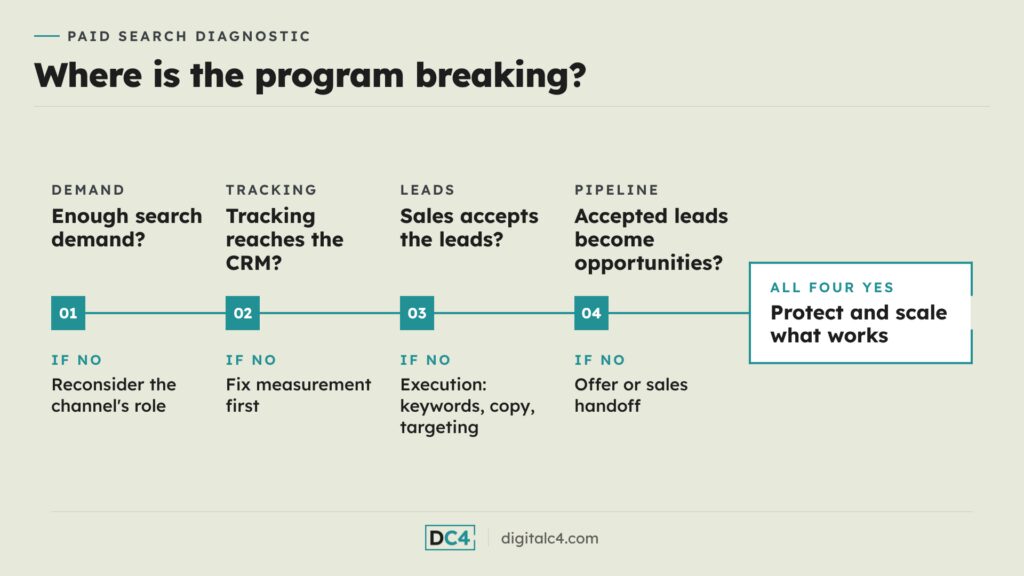
Offer problems are the hardest to see from inside the ad account. Paid media amplifies what the company brings to it, a position our pillar guide covers in full, so check the offer and the handoff before you blame the channel or add spend.
Narrow the Question When the Evidence Is Unclear
When the evidence is incomplete, don’t keep funding the same ambiguity, and don’t shut down a viable channel because the CRM can’t tell the full story yet. Build a short, bounded plan instead.
- Name the decision. Say whether leadership is deciding to protect, reduce, expand, or redesign the program.
- Identify the missing evidence. Choose the gap that would change that decision, such as sales acceptance by campaign or a reliable opportunity source.
- Repair the smallest useful link. Fix the conversion definition, CRM field, routing step, or review habit needed to answer the question.
- Set a review window. Use your sales cycle and baseline to decide when the new evidence will be read.
- Act on the result. Protect what produces quality, change what rewards volume, and revisit channel fit only after execution and offer issues are visible.
The point of the diagnostic is to make your current level of confidence explicit and decide what happens next. Recurring reporting then shows whether that decision is working.
Explore the Full Series
This article is part of DC4’s Google Ads series. The pillar guide covers the full program, and each article below goes deeper on one decision.
The Complete Guide to Google Ads for B2B Lead Generation
How B2B marketing leaders should evaluate, fund, and measure Google Ads.
How Google Ads Account Structure Affects Your Pipeline Visibility
Structure the account so leadership can see which campaigns produce pipeline.
Choosing the Right Keywords for B2B Google Ads
Evaluate keyword choices by the buyers and pipeline they produce.
Using Google Ads Copy to Filter for Qualified Leads
Use message, qualifying language, and landing page continuity to attract stronger prospects.
How to Read and Act on Google Ads Performance Data
Build a reporting rhythm that accounts for conversion lag and turns signals into decisions.
Frequently Asked Questions
Follow paid search leads past the form. If sales accepts them, they become opportunities, and some of those opportunities move forward, the program is producing pipeline. If lead counts rise while acceptance and opportunity creation stay flat, it’s producing leads the business can’t use.
No. A reliable CRM connection and accurate source data matter more. We use offline conversion imports only when the CRM data is clean enough to trust, because importing inconsistent records makes automated bidding look more precise than the evidence supports.
Reduce spend when relevant search demand is too thin or too expensive for your deal economics. Fix the program when demand exists but targeting, tracking, or copy reward the wrong behavior, or when the offer and handoff are failing plausible buyers. Diagnose which one you’re facing before you decide.
Name the decision you need to make, find the one missing piece of evidence that would change it, and fix that link first. Set a review window based on your sales cycle, then decide. Inconclusive evidence is a reason to narrow the question, and it shouldn’t become a reason to keep spending without one.
Start With the Evidence You Already Have
You don’t need a perfect CRM to begin. Pull last quarter’s paid search leads, check how many sales accepted, and see how many became opportunities. That one view often shows where the chain breaks.
If you want an outside read, we can run the diagnostic with your team and show you whether the gap is channel, execution, or offer.
