
Google Ads copy is the first qualification step in a B2B funnel. Good copy tells the right buyer the ad is for them and tells everyone else to keep scrolling, even when that costs some clicks.
The rewrite went live on a Monday. By Friday, click-through rate was down and the weekly report had a red arrow next to it. Two weeks later, sales was accepting more of the leads paid search sent over than it had all quarter. Which number would you have taken to the CMO?
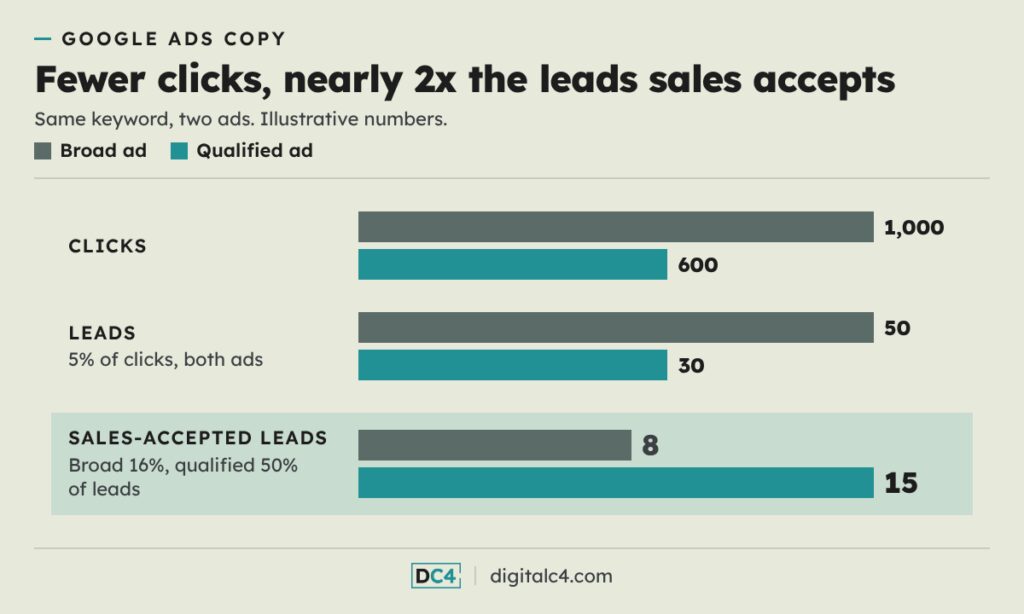
We ask clients to make this trade all the time. When we tighten copy on keywords that attract mixed audiences, CTR usually drops and the share of leads sales accepts rises. On keywords that already signal the right buyer, specific copy can lift both. Either way, click-through rate isn’t the number that decides whether the copy worked.
This article is part of The Complete Guide to Google Ads for B2B Lead Generation and covers how to write copy that qualifies, what it looks like before and after, and how to test it against the leads it produces.
Ad Copy Is the First Qualification Step
Every line in a search ad helps someone decide whether the offer, the use case, and the next step fit what they need. An ad has done its job when the right buyer recognizes the fit and the wrong buyer decides not to click.
In B2B search accounts, we often see copy pulled toward the widest possible interpretation of a keyword. It sounds relevant to almost anyone searching and says little about the companies the business actually serves. The ad earns attention from people whose needs, scale, or intent never matched the offer, and sales spends the next month sorting them out.
Four elements do most of the qualifying work.
- Category language says what the company provides without stretching into adjacent needs.
- Buyer context signals the kind of organization, team, or use case the offer supports.
- Commercial intent makes clear whether the next step is an evaluation, a consultation, a product demo, or an educational resource.
- Proof of fit gives the searcher a credible reason to believe the offer can solve the problem in their search.
Not every ad needs all four. Across the account, though, the intended buyer should be obvious. Can your team say, in one sentence, who should click each ad and who should keep scrolling?
Before and After: Copy That Qualifies
Here is an illustrative example for a company that sells project management software to mid-sized engineering firms. The keyword is the same in both versions.
| Ad element | Before | After |
|---|---|---|
| Headline 1 | Project Management Software | PM Software for Engineering |
| Headline 2 | Start Your Free Trial Today | Built for 50-500 Person Firms |
| Headline 3 | Easy for Any Team or Project | See Pricing, Then Book a Demo |
| Description | Organize tasks, track projects, and collaborate in one place. Get started free today. | Resource planning and project accounting for multi-office engineering firms. |
The before version is written to win the click. A free trial, easy for any team, and nothing that tells a freelancer or a student the product isn’t for them. The after version names the industry and the company size, and it sets the next step as pricing and a demo instead of a free account. Fewer people will click it. More of the people who do will be worth a sales conversation.
Lower Click-Through Rates Are Often the Better Result
Qualifying language works by naming the conditions that make the offer relevant. The strongest qualifiers reflect real commercial boundaries, such as a B2B audience, a company size, a service scope, or a buyer who is ready to evaluate. Pick the one that matches why sales rejects leads today.
| Lead-quality problem | Copy signal to consider | What it filters |
|---|---|---|
| Consumer or very small business inquiries | Explicit B2B, team, or company-size context | Searchers outside the customer profile |
| Early research with no active evaluation | A concrete, evaluation-oriented next step | Informational intent that needs a different offer |
| Requests outside the service scope | Specific deliverable, platform, or engagement language | Adjacent needs the business doesn’t solve |
| Leads expecting a different buying experience | Clear language about the next action and pricing | People who aren’t ready for the commitment |
The trade is worth making when the clicks you lose were never going to buy. Search Engine Land’s Brad Geddes notes that when business and consumer searchers type the same terms, CTR and conversion rate often move in opposite directions. On search terms that already carry industry language, the trade-off shrinks because the audience is already narrow. A cheap click from the wrong buyer is the most expensive click in the account.
Pricing is one of the strongest qualifiers when it’s accurate and stable. A starting price or an engagement minimum filters out buyers whose expectations are far from the offer. When pricing depends heavily on scope, a clear statement of who the offer is for usually qualifies better than a number without context.
Disqualifying language works the same way. A short line such as “for teams of 50 or more” lets the wrong buyer opt out before the click. Use it where sales rejection reasons point clearly to one group, and check that the line still reads as helpful to the buyers you want.
Does the Landing Page Keep the Ad’s Promise?
Message match means the landing page continues the promise, audience, and next step the ad introduced. When it breaks, qualified prospects have to reinterpret the offer after they arrive, and many leave.
A search ad may promise a B2B solution for a specific use case, then send the visitor to a general page that leads with company language and several competing calls to action. The ad attracted the right person, and the page gave them a reason to go. A mismatch like this can look like a traffic-quality problem when the page is the real issue.
The leadership test takes five minutes. Read the ad, scan the page it sends people to, and decide whether the same buyer would recognize the same offer in both places. Our post on why B2B landing pages fail covers the most common breaks.
|
Free guide Make sure your landing page keeps the ad’s promise Check whether the page behind your ad supports the same intent, offer, and next step, so qualified clicks don’t leave after they land. |
Test Copy by the Leads It Produces
Copy tests should compare how messages change qualified outcomes. CTR shows which message attracted attention. It doesn’t show whether the people who responded belonged in the pipeline. Geddes suggests judging ads by conversions per impression, which rewards an ad that earns fewer, better clicks. In B2B, take the same logic one step further and compare qualified leads per impression where volume allows.
- State the qualification hypothesis. Name what the new message should clarify or filter, such as buyer type, use case, scope, or next-step commitment.
- Hold the business question steady. Compare messages within one intent group so the test doesn’t confuse a copy change with a different audience.
- Read top-funnel and downstream signals together. Review clicks alongside sales acceptance, lead disposition, and opportunity movement.
- Choose the message that improves the mix. A version can win with fewer clicks when it cuts poor-fit demand and protects qualified volume.
Copy also has a ceiling. Paid media amplifies the offer a company brings to it, a position our pillar guide covers in full. When qualified buyers read a clear ad and still don’t act, look at the offer before writing another variation.
What Should Leaders See in a Well-Run Account’s Copy?
Sample a handful of ads from the account. Each one should make its intended buyer, problem, offer, and next step clear, and each should belong with its keyword intent and destination page.
- The language reflects the problem sales wants to solve, not only the phrase someone searched.
- Claims are specific enough to set expectations and credible enough for the landing page to support.
- Different intent groups get different promises instead of one generic message across the account.
- Test summaries include lead quality and sales feedback alongside engagement metrics.
A quick way to run this check is to ask for the last three copy tests and the sales feedback that came with them. If every test was decided on CTR, the account is optimizing for attention. If the summaries mention accepted leads, rejection reasons, or opportunities, the team is managing who clicks as well as how many.
Explore the Full Series
This article is part of DC4’s Google Ads series. The pillar guide covers the full program, and each article below goes deeper on one decision.
The Complete Guide to Google Ads for B2B Lead Generation
How B2B marketing leaders should evaluate, fund, and measure Google Ads.
How Google Ads Account Structure Affects Your Pipeline Visibility
Structure the account so leadership can see which campaigns produce pipeline.
Choosing the Right Keywords for B2B Google Ads
Evaluate keyword choices by the buyers and pipeline they produce.
How to Tell If Your Google Ads Program Is Producing Pipeline
Run a leadership-level diagnostic across qualification, CRM evidence, and offer strength.
How to Read and Act on Google Ads Performance Data
Build a reporting rhythm that accounts for conversion lag and turns signals into decisions.
Frequently Asked Questions
Yes, when the clicks it discourages were never going to buy. Copy that names the industry, company size, or next step filters out students, job seekers, and poor-fit companies before you pay for them. The goal is fewer wasted clicks, and the right buyers should still click.
No. Copy can clarify an offer and put it in front of the people most likely to care, but it can’t create demand for something buyers don’t value. If qualified buyers read a clear ad and still don’t convert, the offer, proof, or landing page needs work before the copy does.
Language that reflects a real commercial boundary: the industry you serve, company size, a starting price, a service scope, or the next step you’re asking for. Pick the qualifier that matches the reason sales rejects leads today. Generic claims like “easy” or “for any team” do the opposite.
State what each version is meant to filter, run it within one intent group, and compare qualified leads or opportunities per impression alongside CTR. A version that earns fewer clicks can win if it produces the same or more qualified leads. Give the test enough time for sales to review the leads before calling it.
Make the Next Click More Intentional
Pull your three highest-spend ads and read them as a buyer who shouldn’t click. If nothing in the copy tells that person to keep scrolling, the ad is paying for their attention.
We can review your ad copy against the leads it’s producing and show you where the filter is missing.
